

a new type of design company
AI-Powered World Models for
Every Decision.
we design and implement world models, the spatial intelligence environments that connect assets, cities, and communities to the decisions that shape them. from a single asset to a cognitive city, from capital planning to social infrastructure. one model makes every question answerable and every decision traceable.
studio 2.5 · agentic advisor
● livewhere should our $12M maintenance budget go this year?
across your 3,416 assets, $4.2M of immediate risk is concentrated in HVAC package 3 and electrical distribution. full breakdown with compliance flags and carbon impact below.
what is driving the HVAC risk?
14 elements show condition index below 0.4. IoT confirms abnormal vibration in 6. replacement cost: $1.8M vs $3.4M reactive. net saving: $1.6M.
ask about your assets...
ask →the lifecycle problem
every scale of the built world produces decisions that no one can fully defend.
planning
decisions made from precedent, not evidence
long-range plans at every scale, from a single asset to a regional network, are built on assumptions inherited from the last project. there is no model connecting a planning decision made today to its consequences in year thirty, or to the decisions being made simultaneously by the adjacent organization serving the same community.
design
design intelligence isolated from the people it serves
design teams optimize for delivery. the operational data that would change their decisions lives in a different system. the community experience that would reveal whether the design serves its purpose is never captured at all. maintenance costs, failure patterns, social outcomes, and lifecycle performance never reach the design room in a usable form.
construction
program decisions made without spatial or social context
schedule, cost, and risk are managed in documents disconnected from the geometry they describe and the community they affect. variance is discovered late. the decisions that could have contained it were made without the spatial intelligence that would have made them defensible and without the human context that would have made them genuinely useful.
operations
intelligence destroyed at every handover and every boundary
everything accumulated during design and construction disappears when the project closes. everything learned in one organization stays invisible to the adjacent organization serving the same geography. a housing authority and a healthcare network serving the same residents manage their assets in complete informational isolation from each other. the built world operates as if its parts have nothing to do with each other.
a new kind of company
not an advisory firm.not a software vendor.something new.
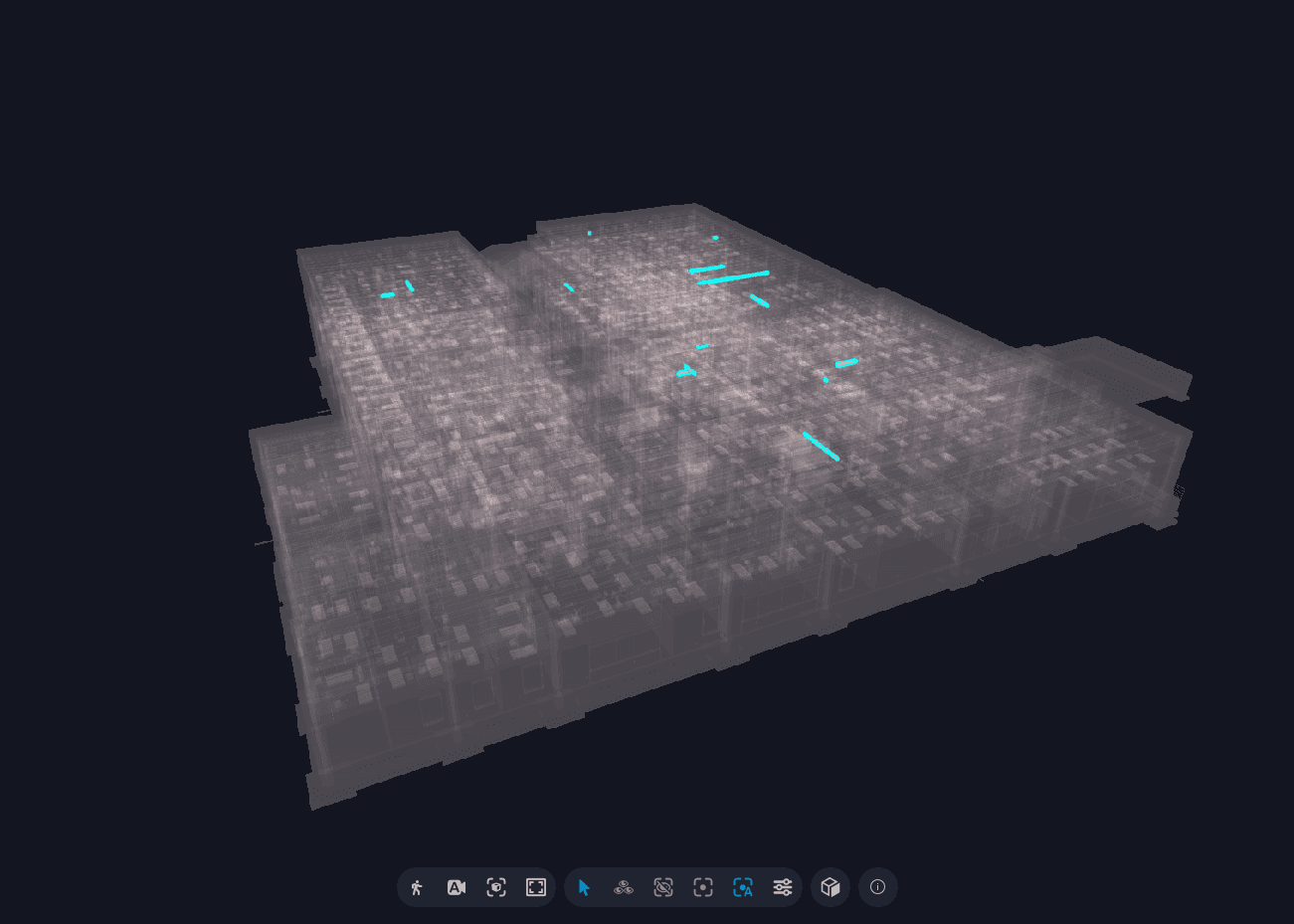
studio 2.5 is a design company that builds world models: spatially grounded, continuously updated environments where every layer of an asset's data converges and AI can reason across the full lifecycle. we then deploy agentic systems on top so capital, program, and operations questions get answers with citations instead of slide decks.

01
Executive Advisory
lifecycle intelligence strategy delivered at the speed of a boutique and the depth of a career. we work upstream of procurement, shaping requirements before architecture is set.
owner side · upstream02
World Model Design
the spatial intelligence layer that unifies BIM, GIS, IoT, and operational data into a single continuously updated environment where geometry is the substrate for reasoning.
3D as code · open schema03
Agentic Intelligence
AI systems that reason across the world model and act. they answer capital, program, and lifecycle questions in real time, with citations, across every phase from planning through operations.
live now · world model + mcpthe wheatgrass principle
one shot glass. 2.5 pounds of intelligence.
one ounce of wheatgrass juice concentrates the nutritional equivalent of 2.5 pounds of vegetables into a single potent dose. not by discarding what the plant contains but by breaking down its cellular structure so completely that what was locked inside becomes fully available. and in that breakdown something new forms. compounds that did not exist in the raw material. supernutrients created by the transformation process itself.
this is what happens when the built world begins to understand itself. intelligence is not missing. it is locked inside fragmented systems and governance structures that were never designed to share what they know. the world model breaks those walls. it concentrates what exists across an asset, a portfolio, a city, or a region into a spatially indexed environment where every question gets a traceable answer.
the sequence we use everywhere is seed, grow, cultivate, transform. soil preparation before acceleration. careful cultivation before the harvest becomes action.
seed
align intent, context, and governance before acceleration. define the decisions that need answers, the human outcomes that matter, and the boundaries for action. whether the context is one asset or a regional network, the work here determines everything that follows.
grow
stabilize data foundations and stand up the spatial intelligence layer. connect geometry, operations, community context, and environmental signals into one working substrate. introduce live reasoning loops so the organization experiences what it means to have an environment that understands itself.
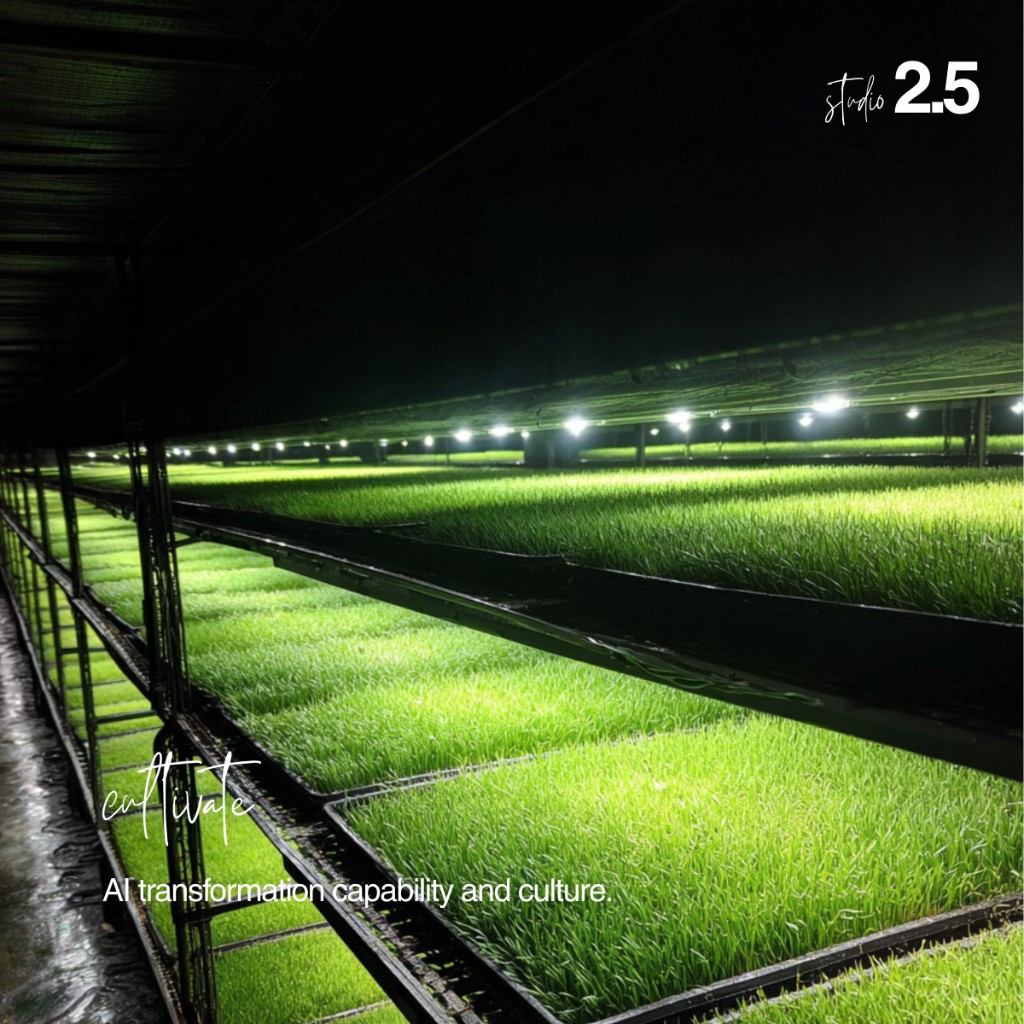
cultivate
connect capital, operational, social, and environmental streams so intelligence compounds across boundaries. multiple owners and disciplines reason together from a common spatial foundation. intelligence stops being a pilot and becomes shared practice.
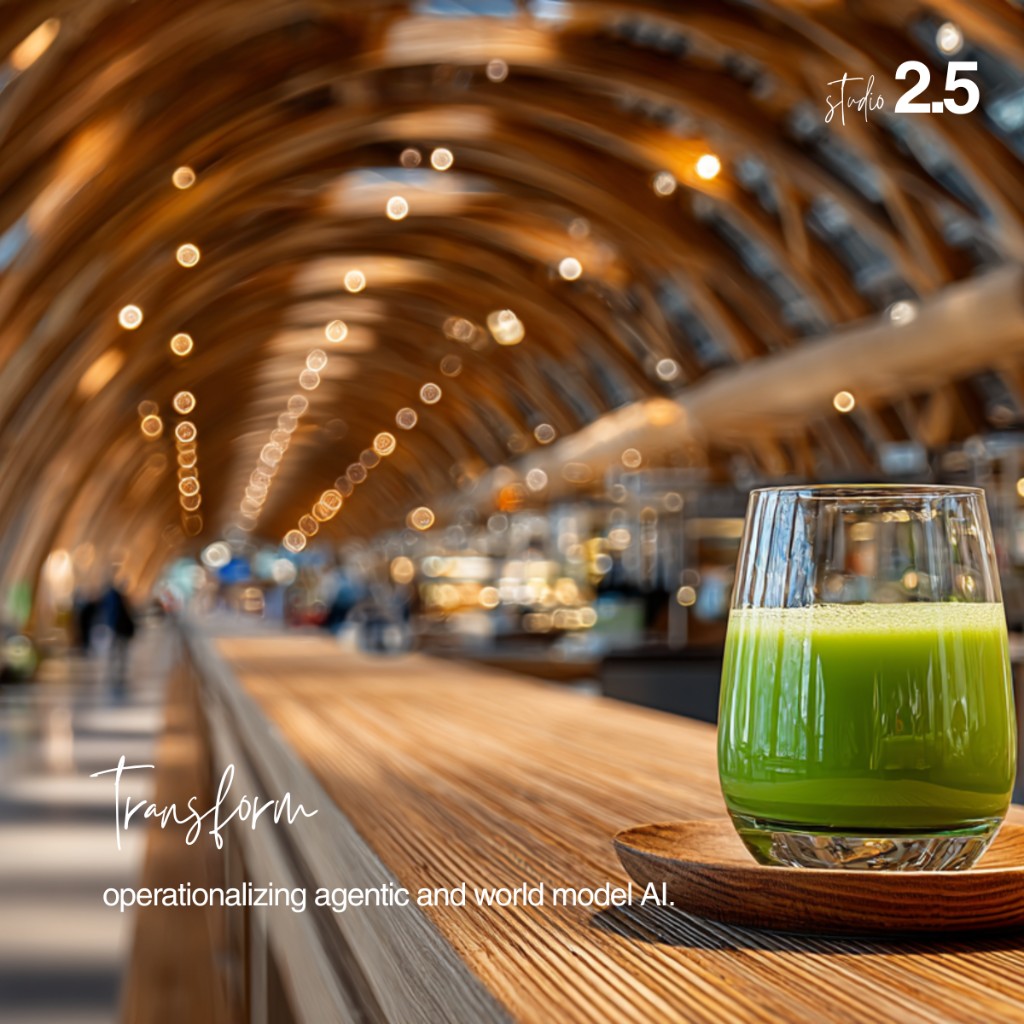
transform
operationalize intelligence into repeatable, traceable, shared action. planning, delivery, operations, and community engagement use the same intelligence at the same moment. each decision enriches the model for the next. systematic change, held by the owner, across the whole life of the asset.
ready to see where you are in the sequence?
start your assessment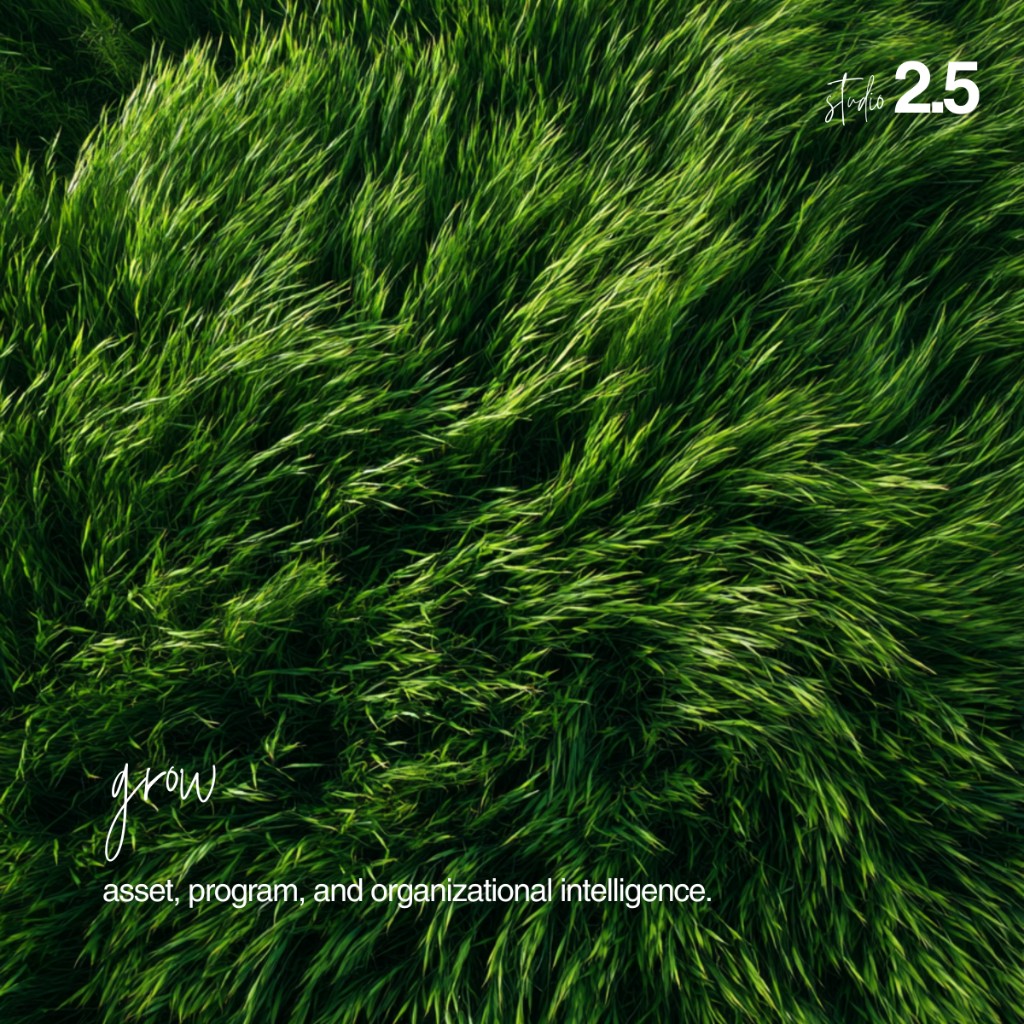
one architecture. every scale.
from a single element to a cognitive city.
asset to portfolio
world model intelligence for owners
capital allocation, lifecycle cost, condition intelligence, program delivery, and sustainability performance across the full ownership lifecycle. every asset decision traceable. every capital investment defensible.
city to region
spatial intelligence at urban scale
connecting transit, housing, healthcare, utilities, and civic infrastructure into a shared intelligence environment. decisions made in one sector visible in their consequences for every other. the cognitive city as a world model at scale.
studio to ecosystem
world model tools for every practice
the same architecture that serves regional governments is available to the smallest practice with the biggest ideas. design studios, researchers, and entrepreneurs building the next generation of spatial intelligence applications.
named intelligence capabilities
five capabilities spanning from city and regional operating systems to asset-level intelligence, built for the decisions the built world most consistently fails to make well.
/8.1
city, regional and national scale decision intelligence
city, regional and national scale decision intelligence
Cognitive OS
/8.2
full lifecycle cost visibility and reasoning
full lifecycle cost visibility and reasoning
TCO Intelligence
/8.3
real time program controls and risk
real time program controls and risk
Program Tower
/8.4
spatial AI as the intelligence substrate
spatial AI as the intelligence substrate
World Model
/8.5
MCP orchestration connecting all data sources
MCP orchestration connecting all data sources
MCP Server
studio 2.5 world model and mcp server
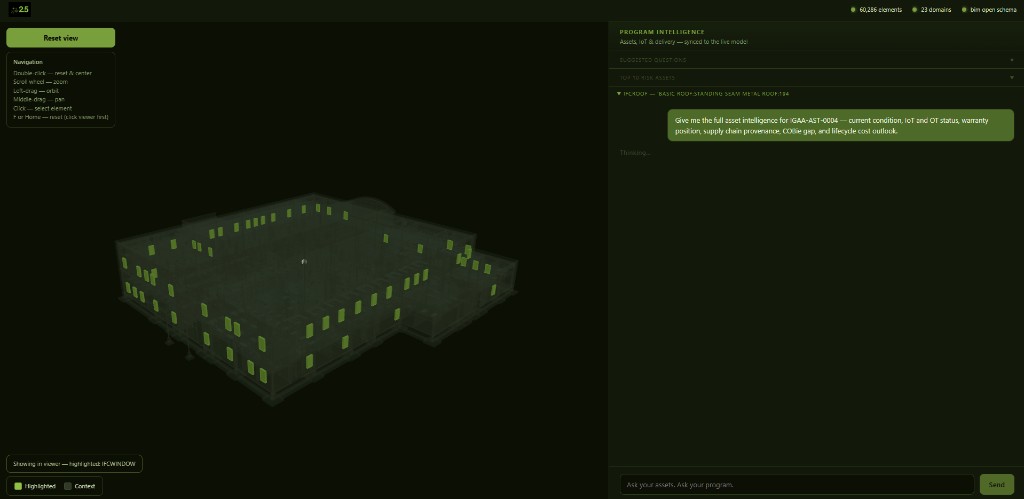
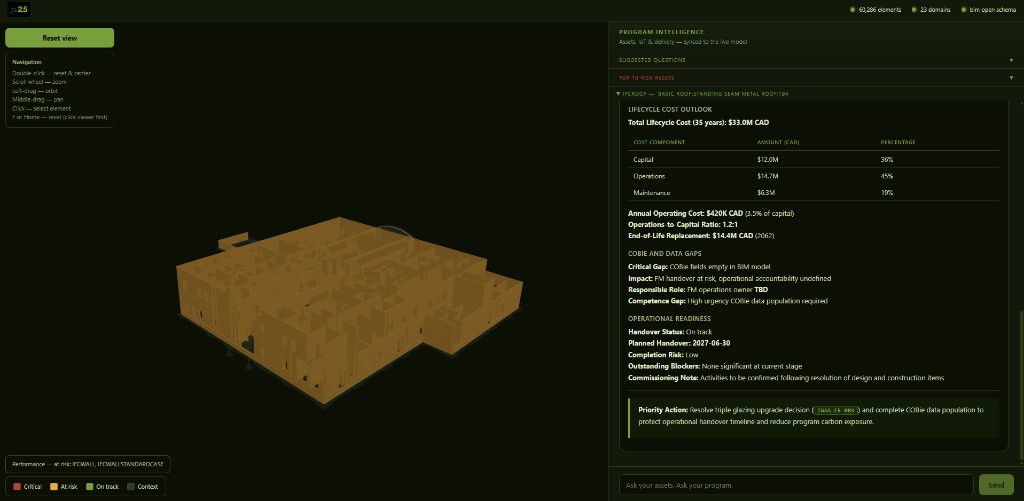
ask a real question. see it spatially. get a sourced answer.
federated ifc and bim geometry across disciplines, every element carrying physical, social, environmental, and financial context, all queryable through an agentic advisor. the mcp server is the orchestration layer that connects your data sources into one live model so any client or agent can reason over what is actually on the ground.
explore the world model →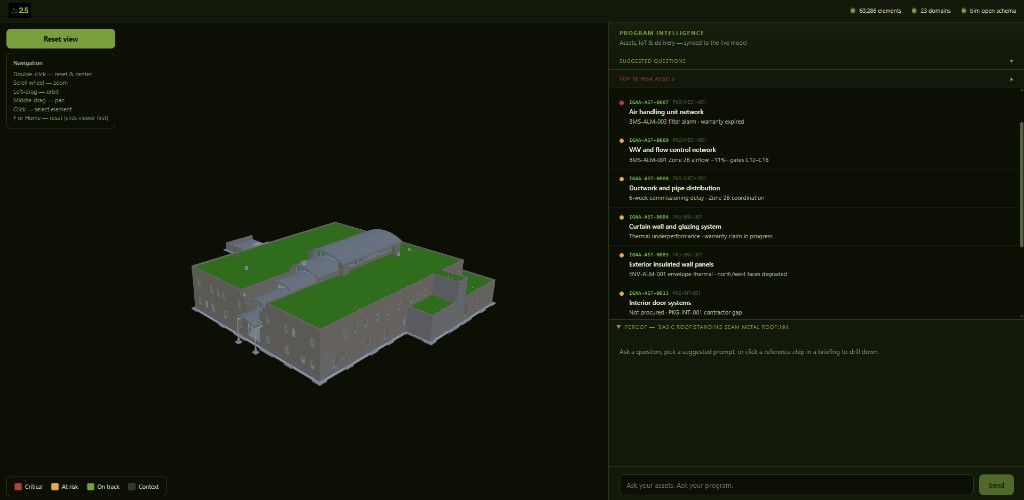
built with purpose.
studio 2.5 is built for the organizations responsible for the infrastructure that defines public life. that responsibility shapes every architectural and design decision we make.
Open Architecture
the world model stack is open. the ontology, connectors, and data transformation primitives are interoperable by design. no lock in. no proprietary dependency on data that belongs to the asset owner.
Human Decision Authority
the AI advises. humans decide. every answer surfaces its reasoning, its sources, and its assumptions. decisions made with this system are defensible in a way that spreadsheet driven decisions never have been.
Carbon as a First Class Output
sustainability impact is embedded in every analysis, not added as a reporting layer after the fact. capital decisions are evaluated for their carbon consequences in real time at the element level.
Capability Transfer
the ambition is an organization that owns its own intelligence layer. every engagement is designed to transfer capability, not create reliance. we build it. you run it.
engage studio 2.5
work with us
you need someone who has lived inside every layer of this stack and can architect the intelligence layer that connects them.
studio 2.5 works with airports, transit authorities, healthcare organizations, and infrastructure owners. we work upstream of procurement, before the architecture is committed. engagements take the form of a strategic advisory retainer, a 90 day pilot, or a focused architecture sprint. the starting point is always a direct conversation about what you are working through.
calendar
book a connect call
choose a time that fits your week. no intake form required to hold the slot.
open calendlystart a conversation